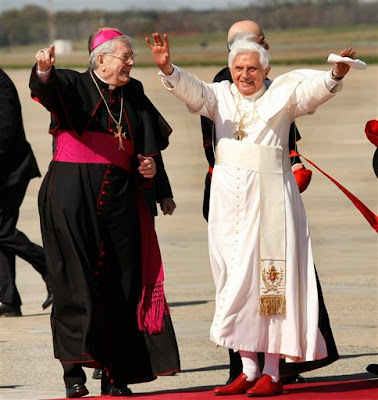
Religion and politics - especially the overlap between the two - is back in the news in a depressingly big way. While much of the attention in recent days has been drawn by the (to some) surprisingly enthusiastic reception given to Ratzo in the USA, closer to home there have been some interesting public interventions and even more interesting surveys.
Tony Blair, in his
speech at Westminster Cathedral earlier this month, repeated the line, fast becoming conventional wisdom, that the notion of a secular society is a myth, or at least passé. "Even ten years ago, religion was still being written off as a force in the world," he said.
But in fact at no time since the Enlightenment has religion ever gone away. It has always been at the very core of life for millions of people, the foundation of their existence, the motive for their behaviour, the thing which gives sense to their lives and purpose to their journeys – which makes life more than just a sparrow’s flight through a lighted hall from one darkness to another, in that memorable image of the Venerable Bede. In the last few years we have been reminded of the great power of religion.
Quite.
Archdruid Rowan Williams has been making speeches, too. In his own Westminster Cathedral
oration the other day, he explained just why he was so keen on the resurgence of Islam:
The growing presence in Europe of a substantial and confident form of classical religious practice in the shape of Islam has put the quest for detached non-sectarian spiritual capital in perspective: post-religious spirituality has to compete with an articulate corporate voice which stubbornly resists being made instrumental to the well-being of an unchallenged Western and capitalist modernity. The natural and instinctive reaction of government is to attempt to co-opt the strong motivations of such corporate vision into the project of strengthening social cohesion.
He also came out with this masterpiece of self-delusion:
The better we understand the distinctiveness of religious claims, the better we understand the centrality within them of non-violence. That is to say, the religious claim, to the extent that it defines itself as radically different from mere local or transitory political strategies, is more or less bound to turn away from the defence or propagation of the claims by routinely violent methods, as if the truth we were talking about depended on the capacity of the speaker to silence all others by force.
As history shows, of course. Ah, but that's not the point:
Granted that this is how classical communal religion has all too regularly behaved; but the point is that it has always contained a self-critique on this point. And that growing self-awareness about religious identity, which has been one paradoxical consequence of the social and intellectual movement away from such an identity, makes it harder and harder to reconcile faith in an invulnerable and abiding truth with violent anxiety as to how it is to be defended.
Harder for who, exactly?
Clearly Woolliams thinks he's on a roll. A lot of media fuss and blather about religion doesn't equate to widespread religious belief, however. Nor does the increasing visibility, and volubility, of semi-professional atheists (the two Ds and the two Hs most prominent among them) represent a tacit acknowledgement that the secularist cause is fading, as is too often claimed. In fact, in much of Europe - at least among the majority - religion continues to fade. Recent figures suggest that almost a half of British people don't belong to any religion, and only 38% believe in God (presumably the 14% unaccounted once came within splashing distance of a font). Religious belief is much stronger in poorer, less developed parts of Europe, such as Malta, Poland and Greece, whereas the most irreligious countries included Scandanavia, France and Britain.
It is in this general atmosphere that we have to understand the current debate: a volume of talk about religion increasing almost daily against a backdrop of longstanding, and growing, public resentment. There are various reasons for this. Most obviously, there's the explosive (literally) re-emergence of religion into public consciousness in the form of Islamist violence. There's also the (partly-related) re-designation of ethnic minority groups as "religious communities". On top of which, the traditional churches, who had (grudgingly, in many cases) begun to accept the relegation of religion to the private sphere - surely the defining characteristic of secularism - have seen the attention being paid to religious "community leaders" by politicians and demanded their piece of the action. The result is, for the indifferent majority, highly paradoxical.
Of course, whatever is widely reported in the media appears to be important, and is apt to be taken for something of great significant by politicians and other framers of public policy. Moreover, the importance of religion to individual believers - and for the truly devout it can be all-important - is apt to be misconstrued as proof that religion is important in itself, and thus that it is the part of the job of government to channel, control, develop, encourage - and fund - religious institutions and religious initiatives. We're told that the aim is to encouraged "social cohesion" and foster neighbourliness and good citizenship. But when you take a look at what is being promoted and funded - factional and sectarian "faith-based" pressure groups like the Muslim Council of Britain, segregationist "faith schools", university training courses and so on - it hardly inspires confidence in the future of an equal, tolerant society.
Perhaps that's why more and more people are apparently coming to the conclusion that religion is a "social evil". That was the most unexpected (and so headline-friendly) finding of the latest
survey(pdf) from the Joseph Rowntree Foundation, released yesterday. It wasn't the only finding, of course. The 3,500 largely self-selected participants in the study (made up of people who had heard about it, or had wandered onto the website by accident, plus a few carefully-selected members of minority groups to make it more "representative") were also bothered about binge-drinking, uncontrolled immigration, the fact that "young people nowadays have no respect", untrustworthy politicians and the unrestrained excesses of big business. Typical Mail readers and grumpy old men, in other words. Their complaints had a timeless quality. It could have been Hesiod, moaning about declining standards in archaic Greece. Or Juvenal, 800 years later in Rome. Or some 18th century moralist. Or Peter Hitchens.
Against this unoriginal backdrop, resentment of religion stands out as something genuinely new. And it's not just resentment of particular manifestations of religion, either: rather, the whole phenomenon of religion is increasingly seen, at least by these participants, as part of the problem rather than as part of the solution. While religion might have been a force for morality and social cohesion in the past, the plurality of religious voices today, combined with the implausibility of their claims, make it unlikely to be of similar benefit today. I quote from the detailed analysis by Beth Watts of the Rowntree Foundation.
Some people saw religion as a social evil because it “undermines social cohesion” and is “a force for separating people”. Participants also felt that religion can actively encourage intolerance, towards some groups in particular: “Faith in supernatural phenomena inspires hatred and prejudice throughout the world, and is commonly used as justification for continued persecution of women, gays and people who do not have faith”. So in stark contrast to those who see the decline of religion as complicit in a decline of values, some participants blamed religion itself for undermining certain values. Another participant highlighted the deficiencies of religion as the basis of a value system for a different reason:
There are too many of them [religions], and none make any sense.
Others were worried about the anti-scientific nature of religious beliefs, and how paying attention to them could undermine progress. Religious extremism was also a particular cause for concern.
So why is the government so keen on promoting something which most people are, at best, uninterested in and which is increasingly unpopular? Two possible explanations spring to mind. One is the long shadow of Tony Blair. It is increasingly obvious just how obsessively religious, and obsessed by religion, the former PM always was. His religiosity was always implicit, of course, but the careful insistence by Alistair Campbell that "we don't do God", coupled with Blair's own reluctance to talk about his convictions, managed to create the impression that this was largely a personal idiosyncrasy. In fact, he moved steadily, and stealthily, to promote a "faith agenda": encouraging faith schools and local activism, setting up ministerial groups and working parties (such as the "Faith Communities Unit" in the Home Office), inviting religious leaders to make submissions on matters of policy, and so on. During his decade in office, much of the machinery of government became accustomed to thinking in "faith-conscious" ways, as well as assuming, as a kind of default mode, that religion is a good thing.
A wholly needless comment in the recent social trends report sums this mindset up very well. "Belonging to a religion can provide a spiritual and a moral framework to a person's life, as well as involving contact with other individuals and participation in the local community," it says in the introduction to the "religion" section. Indeed it can. But so what?
We are still living, too, with the aftershocks of 9/11. In the aftermath of that, and even more so after the London tube bombings of 2005, the government sought to co-opt religious community leaders in the fight against terrorist extremism. And so we saw the procession of bearded reactionaries trooping into No 10 for fruit juice and halal sandwiches. As part of the quid pro quo, the religious "community leaders" were treated as the main interface between the governments and the communities which the affected to represent. Groups such as the strongly Islamist MCB (whose long-serving head, Iqbal Sacranie, had once said that death was "too easy" a fate for Salman Rushdie) gained credibility and funding. And the communities themselves came increasingly to be defined by religion rather than ethnicity. It's difficult to understand how this can be considered progressive, or indeed as progress.
Not only did this process leading to the increasing visibility of political Islam, the most recent manifestation of which is the "Muslims4Ken" campaign in London. It also opened the door to other religious groups who wanted their piece of the action. Hindus formed a Hindu Forum, on the analogy of the MCB. Sikhs protested against a "disrespectful" play by a Sikh woman playwright, and were shamefully applauded by ministers for so doing. Catholic bishops tried to blackmail the government into restricting important scientific research. Anglican bishops are still desperately clinging on to their seats in the House of Lords. Everyone wants more religion-segregated schools, on the absurd principle that the religious affiliation (or claimed affiliation) of parents should determine the quality of a child's education and life chances thereafter.
With Blair out of the way, things may begin to change. Ed Balls, for example, has been notably less enthusiastic about faith schools than his predecessors in the Department of Education (as I intend to continue to think of it). Gordon Brown has spoken a great deal about growing up as the son of a Scottish minister, but in terms of "values" rather than personal belief. I suspect he's secretly an agnostic. Unfortunately governments, like supertankers, take a long time to turn around. And these things develop a tendency to become self-sustaining. If communities conceive of themselves in religious ways, they are quite likely to start voting in religious ways, too. And that really could be the death of secularism.
Expect resigned tolerance for religion to continue to turn, for a growing number of people, into active dislike.
Read the rest of this article